
APPLIED AI

AI that helps quality teams get in control
Turn quality data into action.
Reduce manual work.
Real-time insights.
Faster decisions.
Full auditability.
Recognized by industry analysts. Prototypes validated with customers.

Describe the rule. The system builds it.
Quality systems rely on rules. When something happens, something else should follow.
Normally, setting up those rules requires technical knowledge.
With the Expression Engine Copilot, you simply describe what should happen.
The system converts your description into a working rule inside the workflow.
You decide the logic. The system handles the configuration.
Stop preparing for audits.
Start passing them.
Start passing them.
The audit itself is rarely the problem. The uncertainty leading up to it is.
Compliance Companion runs a complete dry-run of your management system before the auditor arrives. It maps your documentation against your certification norm, reviews your QMS evidence, and tells you exactly where you stand.
You are not afraid of the audit. You are afraid of what you do not know.
What it does:
- Maps your documentation against ISO 9001, FSSC 22000, ISO 14001, and other norms
- Reviews procedures, records, and corrective actions for completeness and traceability
- Produces a gap report: covered, partially covered, missing
- Run it as many times as you need as you close the gaps
Beyond audit prep:
Entering a new market? Select the relevant norm and get a clear picture of your compliance gap in minutes, not weeks.
The result:
An audit you walk into with confidence, not hope.

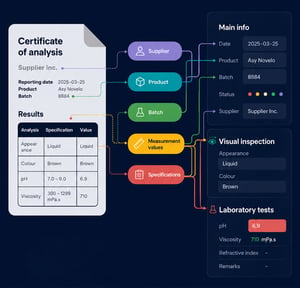
Every supplier issues a different COA. It no longer matters.
Certificates of Analysis, calibration certificates, lab reports. Each one formatted differently. All of them containing data your quality system needs.
Manually re-entering that data is slow, error-prone, and completely unnecessary.
AlisQI's PDF Parser reads your incoming PDFs and extracts the relevant data automatically. Batch details, test results, specifications. Scanned or native. No templates to build. No configuration required.
The data lands where it belongs. Your team doesn't have to touch it.
What it does:
- Extracts batch and sample details, test results, and specifications from any PDF layout
- Works on both scanned and native PDF files, without setup
- Feeds data directly into your AlisQI analysis sets
- Triggers deviation escalation automatically when results fall outside specification
- Archives and makes all incoming COAs searchable
The result:
No manual re-entry. No missed deviations. A complete, searchable record of every document your suppliers send.
Talk to your QMS.
Quality systems contain answers. Finding them usually means navigating menus or building reports.
With AlisQI, you ask a question in plain language.
The system interprets the question, retrieves the relevant records, and shows the results with traceable references.
Instead of operating the system, you query your operational data directly. The permissions and audit trail remain unchanged. What changes is how quickly you get from question to answer.

Turn existing procedures into documentation operators actually follow.
Most SOPs are written by the person who knows the process best. That's rarely the person who writes clearly.
The result:
documentation that satisfies the auditor and confuses the operator.
The Smart SOP Rewriter analyzes your existing procedure and rewrites it according to quality documentation best practices. Active voice. Clear ownership. Unambiguous steps. Validated against your certification norm in the same pass.
You bring the process knowledge. AlisQI makes it readable.
What it does:
- Surfaces structural and clarity issues in your current SOP
- Rewrites in active voice with clear role ownership and step logic
- Converts text-heavy processes into diagrams where it helps
- Validates against your relevant certification norm
The result:
Faster training. Fewer deviations. Documentation you're proud to show an auditor.


Predict risk before it becomes a problem.
Quality risk is no longer just about what went wrong - it's about what's likely to go wrong next. AlisQI's Pattern AI continuously analyzes structured data and incident descriptions across your operations to surface emerging risk signals before they escalate.
What it does:
-
Detects risk patterns across product lines, production environments, and supplier history
-
Surfaces comparable past cases with root causes and corrective actions - instantly
-
Supports your risk evaluation process, not just incident lookup
-
Available as a standalone risk solver, or embedded across QMS workflows
The result:
Fewer recurring problems. More consistent decisions. A quality system that gets smarter over time.
Stop building forms. Have AI do it, without the consultancy bill.
A paper checklist, an Excel sheet, or a plain-language description. That's all you need.
AlisQI's Form AI analyzes the structure, identifies fields and data types, understands basic logic, and generates a fully structured digital form - ready for refinement inside your system.
What it does:
-
Generates forms from Excel, photos, or a text description
-
Recognizes fields, headings, logic, and data types automatically
-
No manual rebuilding. No technical setup.
-
Manage everything in-house - no consultancy required
Beyond forms:
Build bots directly into your workflows for automated data collection, checks, and process handoffs
The result:
What used to be a configuration project becomes a starting point in seconds. New workflows launch faster. Legacy paper forms get modernised without outside help.
